All About DAF (Dissolved Air Flotation)
A major reason behind constructing the new West Parish Water Treatment Plant is to address disinfection byproducts, or DBPs. Commission customers received public notices about one type of DBP, known as “HAA5,” again this summer.
First, some background: disinfection byproducts were first regulated after the existing West Parish Filters Water Treatment Plant was last modernized in 1974. Additional DBP regulations were introduced in 1998 and updated in 2006 for implementation by 2012. With climate change now driving more extreme weather patterns, such as prolonged rainy periods following prolonged dry periods, the existing filters cannot remove enough dissolved natural organic matter (or “organics”) that washes into the reservoir to meet today’s DBP regulations. (DBPs form when organics interact with chlorine.)
In response, the new West Parish Water Treatment Plant will feature Dissolved Air Filtration, or DAF, technology. Since DAF is the key to resolving elevated DPBs, we thought it deserved a little more explanation.

Is this a new technology?
While DAF will be new to our water system, it’s been a widely adopted technology for generations. DAF was pioneered in the 1920s by industrial users looking for a method to separate solids, liquids, and oils. European municipal drinking water plants began using it in the 1960s to remove algae and natural organic matter.
In drinking water treatment, DAF is considered a “clarification” step that takes place before filtration, removing organics that have dissolved in the water from decaying leaves, twigs, etc., that are naturally occurring on the forest floor. It does this by blowing tiny air bubbles into the water, which float the dissolved organics to the top where they can be skimmed off.
Over the years, as technology became more efficient to operate and effective at removing tiny particles, DAF has become more common in U.S. water treatment facilities.
Is DAF a common solution in New England?
Several plants in Massachusetts and Connecticut use DAF, indicating its effectiveness in tackling water treatment challenges similar to ours:
Cambridge Water Treatment Plant: Uses DAF as part of its multi-barrier treatment process.
Amesbury Water Treatment Facility: Upgraded (2010-2012) to include DAF technology to improve water quality.
Lenox Water Treatment Plant: Installed in 1982, it was the first potable DAF filtration plant in the Americas.
Milford Water Treatment Facility: Uses DAF clarifiers for treating lake and river water.
Groton Water Treatment Plant: Upgraded in 2022 to include DAF and manganese adsorption contactors.
What makes DAF right for Springfield’s water quality issues?
In 2019, the Commission began a pilot study with UMass-Amherst to identify the most appropriate treatment process to meet the Commission’s water quality goals. As part of the pilot study, several treatment techniques were evaluated:
pre-oxidation with chlorine dioxide,
different coagulants with direct filtration (our current type of filters), and
DAF with filtration.
The study concluded that DAF followed by conventional dual media filtration was the most effective solution to reduce DBPs and improve water quality.

How does DAF work?
Water from Cobble Mountain Reservoir will flow through the new West Parish Water Treatment Plant by gravity. Raw water will enter the plant on the south side, where it will be dosed with coagulant, mixed, then conveyed through one of ten trains of flocculators (mixers) and DAF basins.
Here’s where it gets technical: Microbubbles injected into the water in a DAF basin will glom onto the “flocc” (coagulated organics that form during flocculation). Like tiny balloons, the bubbles change the specific gravity of the flocc, making it less dense than the water, and lifting it upwards. The flocc forms a sludge mat on the water’s surface with an earthy smell. This mat represents the “organics” that our existing filtration process has a harder time removing.
These solids will then be removed by mechanical skimmers that scrape them into a collection trough. The solids will be pumped to a dewatering building for further processing.
By the time the treated water goes through the disinfection process, there will be less organics in the water with which the chlorine can interact, thus reducing the formation of DBPs.
Sounds complicated. Is DAF expensive? Is it energy intensive?
The DAF process is more energy-intensive than our existing methods, but it represents a significant advancement in treatment standards that will improve water quality.
Adding DAF introduces more equipment and processes, requiring additional operator certifications and headcount. West Parish staff are already working on upgrading their treatment licenses to be ready for the new plant. Managing the sludge or “residuals” will also require a new process to handle thicker solids with new dewatering facilities onsite.
What happens to the sludge captured by this process?
The DAF and filtration processes produce accumulated solids that require management and disposal. At the existing plant, backwash water from the cleaning of the existing dual-media filters (known at West Parish as the “rapid sand filters”) is currently discharged to Cook Brook and directed to lagoons where solids settle and accumulate, and must be periodically cleaned out.
In the new West Parish Water Treatment Plant, most solids will be generated through the DAF process. These solids will be “dewatered” using centrifuges and transported by truck for disposal off-site, likely at a landfill.
Are the DAF basins being built yet?
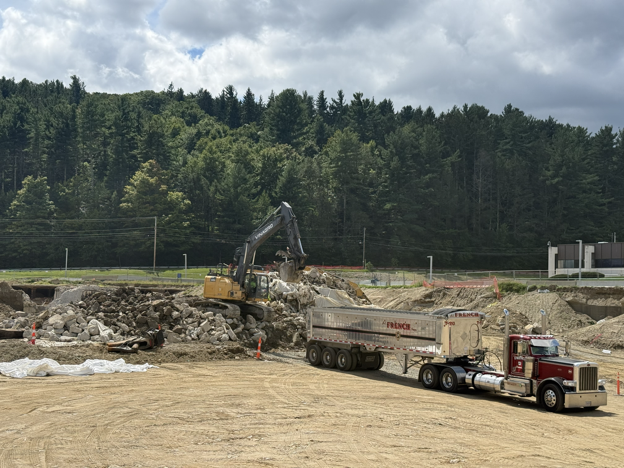
The construction of the DAF basins is still several steps away and will be built in the footprint of eight old slow sand filters, which are currently being demolished to make room for the new plant. Keep an eye on this page for updates as construction progresses.