A Fond Farewell to the Slow Sand Filters
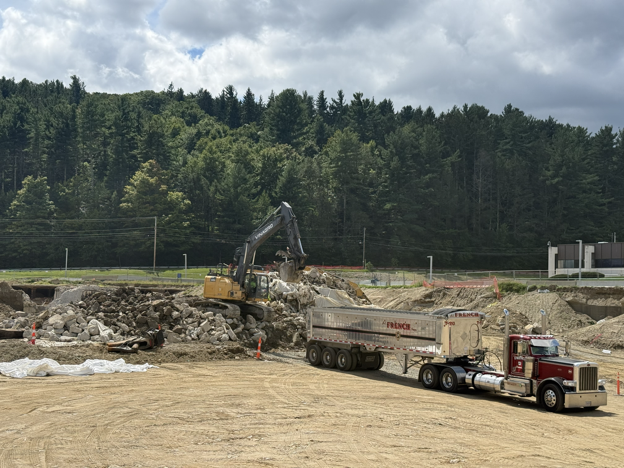
On Friday, August 22, 2025, Water Operations staff gathered at West Parish Treatment Plant to give a final farewell to the slow sand filters. The construction schedule of the new water treatment plant is set to move on to the demolition phase, but the milestone could not pass without acknowledging the immense service these filters have provided to the Springfield region for a century.

The commemoration was opened with Deputy Director of Water Operations Christina Jones and Communications Manager Jaimye Bartak explaining the history of the slow sand filters and sharing copies of Springfield Daily Republican newspaper clippings from the time of their construction one hundred years ago. At the time, additional filter beds were needed to keep up with quickly rising consumption demands in the city.
A collection of the Springfield Daily Republican newspaper clippings detailing the significance of the slow sand filters’ construction in 1925.
When slow sand filters were first constructed at West Parish in 1909, they were considered state-of-the-art technology and designed by leading engineers. The filters required large amounts of physical labor to maintain and clean, including shoveling “schmutzdecke” (a biological layer that forms on the top of the sand and traps bacteria and particles) that takes as long as two weeks per filter.
Three of the six Slow Sand Filters built in 1909 were demolished as part of the 1974 construction of the rapid sand direct filtration plant. The remaining three 1909 slow sand filters were demolished in 2022 to provide space for the new Backwash Facility, which was completed in 2023. The 1925 and 1966 filters remained in service up until late 2024.
Now the 1925 and 1966 slow sand filters will be demolished to make way for the new state-of-the-art West Parish Water Treatment Plant. Four beds on the other side of the campus dating from 1952 will remain but will not be in service when the new plant comes online.
To say their farewells, staff entered the slow sand filters where they shared memories of their time working in the large underground caverns, often the first assignment of their water careers. (One even relayed a ghostly experience of noticing small footprints mysteriously appear in the middle of the freshly shoveled sand!) Commission staff also voice appreciation for the many employees who have worked to clean and maintain the filters over the past century.
Considering how well-built they were, the slow sand filters perhaps could have kept on for another century, but of course the world (and especially drinking water regulations!) around them has changed. We are appreciative for their 100 years of service, and are excited for the modern dissolved air floatation and rapid sand filtration technology that will take their place!