Other Projects at West Parish: Lagoon Cleaning Project
Updated: Feb 24

The Lagoons at West Parish Filters
The Lagoon Cleaning Project kicked off in summer 2025.
Two lagoons play a critical role in the filter backwash (or cleaning) process of the existing water treatment system at West Parish Filters. During backwashing, water flows upward through the rapid sand filters to clean the filter media of the natural organic materials and other residuals that the treatment process removes from drinking water. The backwash water carrying the collected residuals is sent to the lagoons, where the solid residuals settle out over time. Over the years the solids accumulate in the lagoons, and cleaning is required.

Operational and Regulatory Need
The last lagoon cleaning project took place over ten years ago and a residual accumulation study determined the lagoons would be full again by 2025.
To maintain operations for the next several years before the new plant is brought online, the study determined a cleaning project was necessary. It also determined that without any cleaning or mitigation efforts, further accumulation of solids in the Lower Lagoon could have the potential to reach the outfall – impacting regulatory compliance with the site’s National Pollutant Discharge Elimination System (NPDES) permit.
Project Scope
Staff from the Commission’s Engineering and Water Operations divisions worked closely with project consultants to complete the project.
The pre-construction phase of the project included planning and design, as well as permitting, which was an extensive process due to the need to dispose of the residuals off-site.
Once construction began in summer 2025, work focused on removing built-up sediment from the lagoons and safely handling the leftover material.
To do this, crews used hydraulic dredging, which is a floating machine that moves across the water. This machine uses powerful pumps to suck up mud and sediment from the bottom and move it through large hoses. This method is efficient and helps minimize disruption to the surrounding area.
After the sediment is removed, the remaining material, called residuals, needs to be dried out and disposed of properly. Crews used belt filter presses, which dry the material on moving porous belts (a process also called “dewatering”). The drier the material, the easier and more cost-effective it is to transport for disposal.

Construction at West Parish Filters
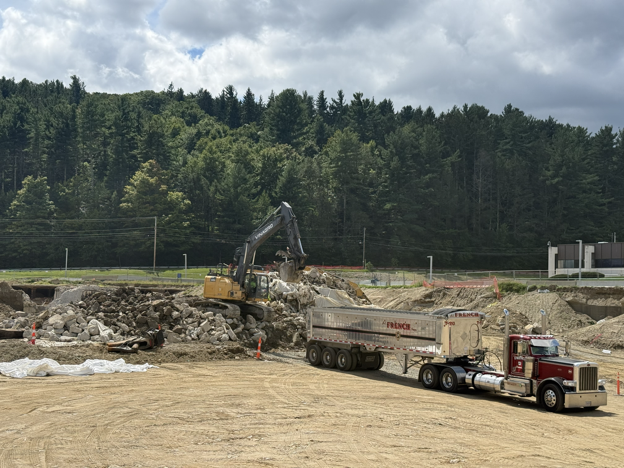
The Lagoon Clean Project is just one of several capital projects taking place on the West Parish campus – adding to a flurry of construction activity, trucks, equipment, and labor staff.
Work on the Lagoon Cleaning Project continued throughout the fall and was completed in late 2025. Careful consideration was taken to ensure that the simultaneous construction projects did not cause disruptions or unplanned impacts to daily water treatment operations. The location of the lagoons on the far edge of the West Parish campus also helped to reduce any impact.
The New Plant and the Lagoons
Although the existing plant still depends on the lagoons and will need them for the next few years, the new water treatment plant will no longer use them. Instead, residuals will be handled through a modern dewatering centrifuge, with remaining solids transported off-site for disposal.
Further analysis and long-term planning is underway to rehabilitate the Upper Lagoon into a natural site after the new plant is fully operational, and the residuals storage of the lagoons is no longer needed.

Financing
The $4.1 million Lagoon Cleaning Project was being financed by a low-interest loan from the highly competitive U.S. Environmental Protection Agency’s (EPA) Water Infrastructure Finance and Innovation Act (WIFIA) Program. The Lagoon Cleaning is also one of more than twenty projects included in the Commission’s Water and Wastewater Infrastructure Renewal Program – a generational reinvestment to modernize the region’s water and wastewater infrastructure.